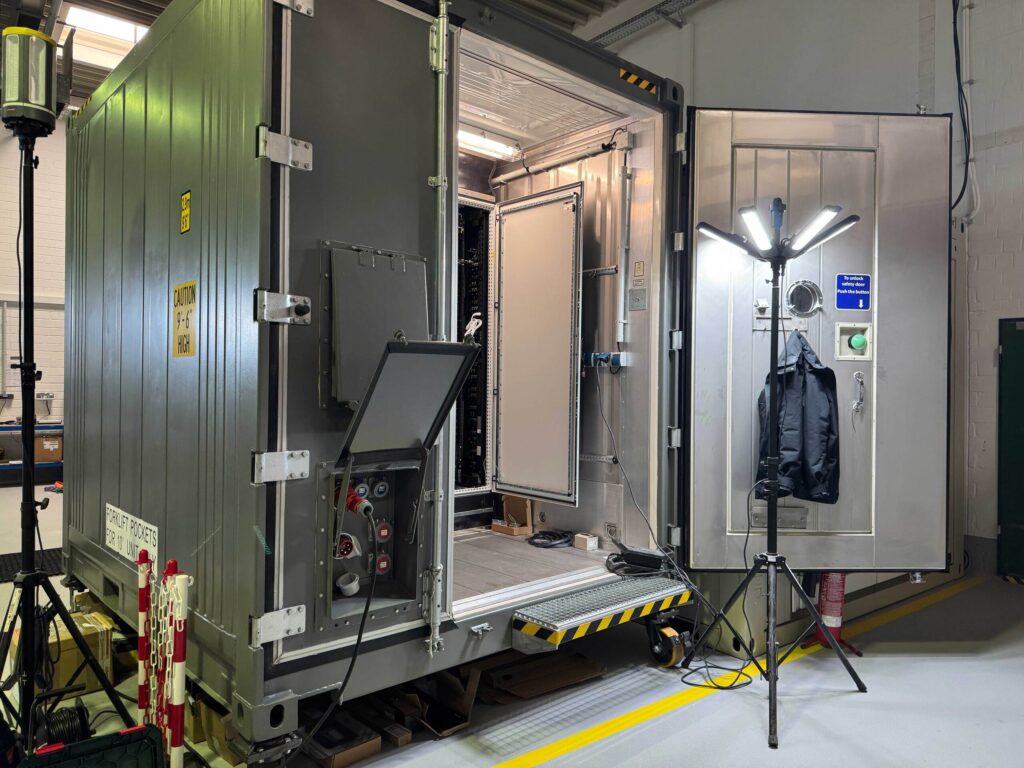
Sometimes, you just need to step away from your desk, swap your smartphone for a cordless screwdriver, and brush the dust off your hands to remember why we love our jobs so much. That is exactly what happened to us recently. Working in IT sales and managed services, we usually operate in a global landscape of concepts, SLAs, and virtual architectures. But then, that one project comes along that completely flips everything upside down. Suddenly, you find yourself standing inside a brand-new 10-foot refrigerated container originally built to transport tons of fresh fruit across the world’s oceans. Our client, a renowned German research institution that carries out most of its missions and measurements at sea, was facing a massive challenge.
Anyone familiar with maritime research knows just how brutal conditions out on the ocean can be. Previously, every new expedition required a monumental logistical effort because the IT infrastructure had to be painstakingly set up and cabled on board for each project, only to be dismantled again after the journey. The results were immense time loss, the constant risk of transport damage, misplaced cables, and an IT setup highly vulnerable to the unforgiving environment at sea. The vision was as simple as it was brilliant. What they needed was a mobile, self-sufficient data center based on a “drag & drop” principle – something that could simply be craned onto the ship’s deck, plugged in, and powered up immediately. A permanent, clean cabling system that stays put meant absolute reliability and maximum protection for highly sensitive research data.
Engineering against the elements
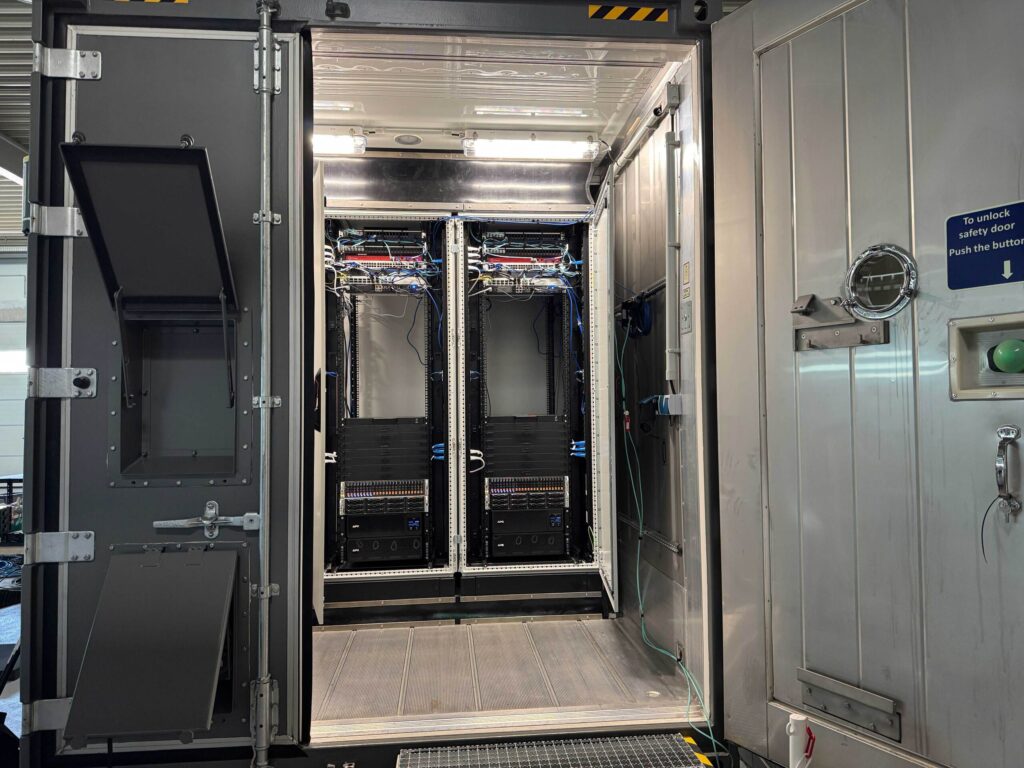
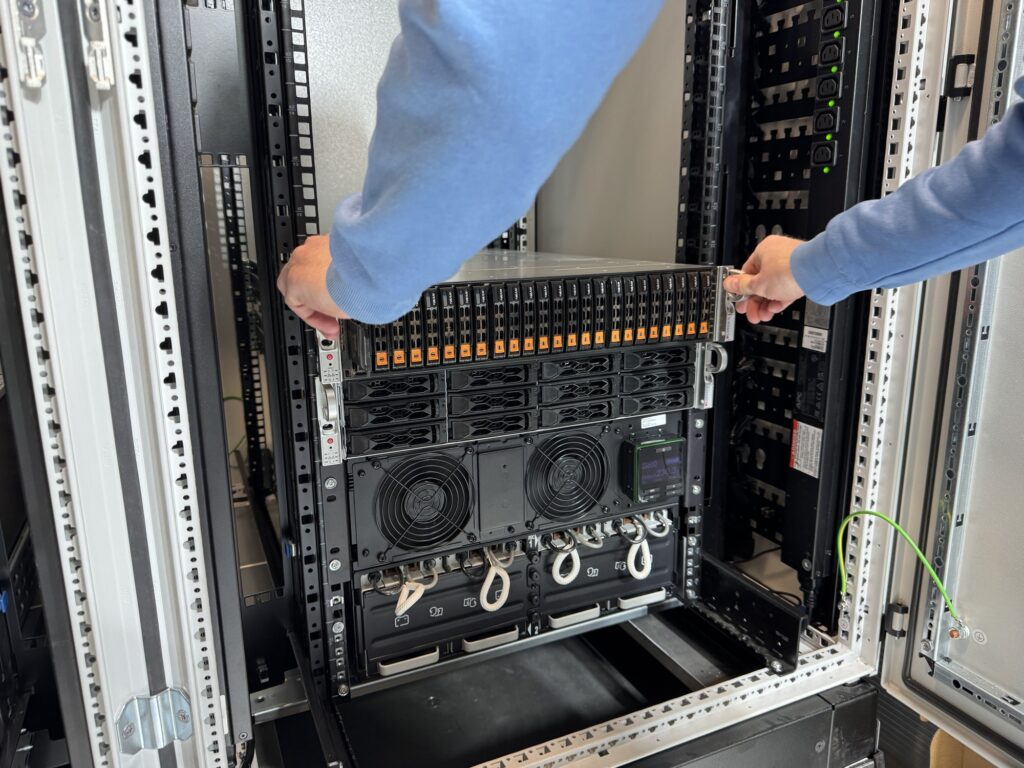
Building a data center on land is standard practice, but gearing up a data center to withstand the pounding of waves, aggressive sea air, and the scorching sun on the Atlantic requires true engineering passion. As a team, we had to rethink our entire approach, starting with the server racks. When a ship works its way through heavy waves, it creates vibrations that would destroy any standard server hard drive in no time. That is why we mounted two massive, completely galvanically isolated racks on heavy-duty shock absorbers and springs designed to easily buffer every shock from the ship. The architecture prioritizes uncompromising fault tolerance through strict separation, with each of the two racks forming a completely autonomous unit. An individual UPS sits at the bottom of each rack, dedicated solely to buffering that specific system. While this might look unusual to traditional data center planners at first glance, the deeper purpose of galvanic isolation lies in its bulletproof resilience. If one rack or power side fails entirely, the other continues to run seamlessly as an active/active or hot-standby cluster. The racks are interconnected via fiber optic cables, and we consistently used OM3 cabling throughout the entire container. Why? Because on the ultra-short distances inside a 10-foot container, deploying OM4 would have been pure overkill, whereas OM3 provides the perfect, entirely dependable performance for the required bandwidths. Far more critical for the harsh conditions at sea was the mechanical protection anyway, which is why every single cable was installed with an extra-robust shielding and a clean strain relief. Inside the racks, however, we rely on classic copper-based connections. The physical accessibility also put our problem-solving to the test, since there is no rear aisle behind the racks in such a tight container. We had to develop an assembly strategy where the hardware is installed in a strictly defined order, given that access is exclusively available from the front. Every cable had to be structured and routed from the ground up so that any later component replacement could be done blindly on a stormy sea in just a few simple steps.
Stable power, focused cooling, and a direct line to space
A critical cornerstone of this project was electrical engineering, because power on a ship is a science in itself. To protect the sensitive IT components from the frequently fluctuating onboard power grids, a dedicated, massive transformer inside the container cleanly filters the electricity before passing it to the UPS systems. Combined with a central M12 grounding screw that connects the entire mobile data center directly to the ship’s hull, this construction effectively shields against voltage spikes and leakage currents. This also applies to the main power lines: heavy power and communication cables are routed safely inside through specialized custom plates in the door, while sea air, moisture, and corrosion are kept firmly outside. Heat was another major issue, as the hardware used to run extremely hot whenever the sun beat down directly on the port or starboard side. Since the container is a purely functional space and not a permanent workstation, we were able to radically optimize the climate control. Instead of wasting massive amounts of energy trying to cool down the entire interior, we implemented smart rack containment. The cooling capacity of the former fruit container is directed precisely at the active hardware components, which saves an immense amount of energy on board and guarantees an optimal operating temperature. Because the container usually remains locked during research expeditions, a comprehensive sensor network throughout the interior takes on the role of a silent guardian. These sensors continuously monitor parameters like temperature, humidity, or smoke development, routing this data directly through the internal server infrastructure and network. This is where the bridge back to our home base comes in, as the container’s entire connection to the outside world relies on high-performance Starlink antennas. Telemetry data flows directly into our weSystems monitoring systems via this satellite uplink. From land, we handle the complete, 24/7 operations and guarantee the reliable availability of all hardware components around the clock – regardless of whether the container is currently sitting in the harbor or cruising the middle of the Atlantic. Thanks to this robust processing power directly on board, the researchers can now pre-process their data right on the ship and transmit initial results back to shore immediately, making the agonizingly long delay between data collection and the first analysis a thing of the past.
Team spirit on equal footing and the sweet taste of success
Beyond all the technical finesses, what truly made this project special was the human element. It was a collaboration on equal footing that was simply a blast from the first sketch to the final screw. A true highlight of the cooperation was the division of labor during assembly: we took care of the mechanical and structural infrastructure, but the client’s engineering team insisted on handling the installation of their highly sensitive, specialized equipment for measuring-instrument control. We left precisely calculated gaps in the racks for exactly these devices. In the end, we stood together in that container, sweating, cursing, laughing, and handing each other tools. That is exactly the kind of team spirit that drives us. After intensive weeks and a series of successful stress tests and simulations, we were able to officially complete the project. The container is perfectly configured, fully seaworthy, and stands ready as a turnkey system for its future missions across the world’s oceans. We are incredibly proud of this joint achievement with our client. When the lines are finally cast off in the harbor soon, we will know that a real piece of weSystems engineering is out there riding the waves.
Fair winds, following seas, and successful researching! Cast off!
Whether on stormy seas or in a classic server room on land, in the end, companies everywhere face the exact same task: your IT infrastructure must run with absolute reliability so that you can focus entirely on your core business. This is exactly where we come in.
Whether it involves tailor-made custom builds like our mobile data center or the daily, seamless operation of your standard systems, we support you as a dedicated partner. If you are facing the challenge of strategically developing your IT infrastructure while remaining fully agile and operational, it pays to take a pragmatic approach far beyond ideology and empty buzzwords. Let’s start a conversation and see how we can set up your IT landscape to be stable, future-proof, and flexible. Exactly the way it fits your business best.